Showing posts with label Italy. Show all posts

Wednesday, November 13, 2013

Dario Mitidieri | Calabria's Holy Blood

Photo © Dario Mitidieri-All Rights Reserved

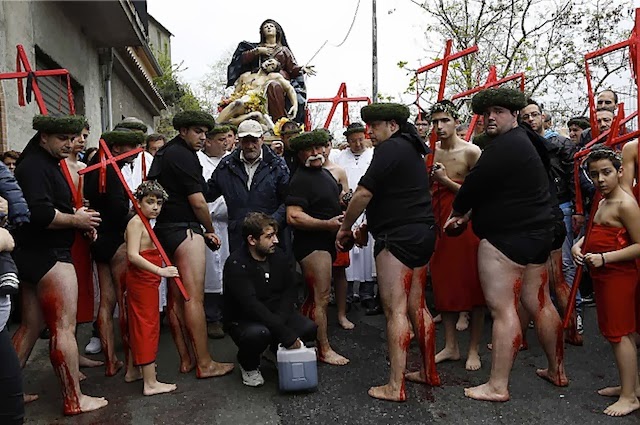
In villages of the region of Calabria (southern Italy), the Rito dei Vattienti (or Rite of the Beaters) is an annual religious event dating back to 1473. It's during the event that devout Catholics flagellate themselves during a procession, carrying a statue of the Virgin Mary.

The flagellation is a manifestation of extreme religiosity, and is performed as means of cleansing one's soul. The tool used to draw blood is called "cardo"; a paddle made of cork is embedded with shards of glass, and is used to by the Vattienti's to beat their thighs and legs during the procession, while another piece of cork is used to cleanse the wounds. The flowing blood is then washed off to the streets with red wine.

Dario Mitidieri is an Italian photographer, currently based in London where he studied photojournalism and works as freelance. 


His major photographic assignments include: the plight of the Kampuchean refugees in Thailand; the Tiananmen Square massacre; German reunification; the cyclone in Bangladesh; the fall of the communist regime in Albania; the destruction of the Ayodhya Mosque in India and the subsequent communal violence in Bombay; Ayrton Senna’s last race; the refugee crisis in Rwanda; the Kobe earthquake in Japan; "children at war" in former Yugoslavia, Ethiopia, Rwanda and Angola; Charismatic Evangelism in the USA, England, India and Korea; the last Masaai in Kenya; the fall of Baghdad and the mass graves of Iraq; the aftermath on the Tsunami in Indonesia.


In 1992 he spent the whole year in Bombay documenting the lives of street children, and produced his book Children of Bombay (1994) which was translated into six languages.

His photograph of a young girl street acrobat in Bombay (from the above mentioned book) was featured as the cover for the magnificent novel A Fine Balance by Rohinton Mistry which is set between 1975 and 1984 during the turmoil of The Emergency, a period of expanded government power and crackdowns on civil liberties in India.


Tuesday, February 7, 2012

Christopher Thomas: Venice In Solitude

Photo © Christopher Thomas-All Rights Reserved

Today's post is at 180 degrees divergence from the one yesterday, as it features the beauty of the La Serenissima or the Most Serene; term that was applied to the Republic of Venice. I believe its Carnavale (its most internationally known festival) will be celebrated in less than two weeks, and is a perfect time to feature the phenomenally beautiful photography of Christopher Thomas.

Christopher Thomas is based in Munich, and graduated from the Bavarian State Teaching Institute for Photography. He works internationally as a renowned advertising photographer., while his photojournalism for Geo, Stern, Süddeutsche Zeitung Magazin, Merian, and other magazines received many international prizes.

His atmospheric photographs of Venice are currently on show at the Hamiltons Gallery in London, which I walk past often when I'm there. Unfortunately, I will not be in London during the exhibition which ends on February 27, so I have to content myself with viewing these online.

It appears that Christopher would set at the crack of dawn with a large format camera, lenses, a tripod and boxes of Polaroid Type 55 to make his photographs.

Christopher has also photographed in Nepal and Ethiopia, amongst other places, so visit his website.

Other websites with his work is the BBC In Pictures and Ira Stehmann.

Sunday, December 4, 2011

Venice By FKY


For a complete change of pace this Sunday, I feature a wonderful short movie on Venice produced by FKY, presumably a French videographer from Nantes.

What hooked me to watch this movie was the opening song by Charles Aznavour "Que C'est Triste Venise"...a romantic but sad song whose lyrics start:

Que c'est triste Venise,
Au temps des amours mortes,
Que c'est triste Venise,
Quand on ne s'aime plus.
Charles Aznavour is is an Armenian singer, songwriter, actor and a public activist. He's one of France's most popular and enduring singers, is known for a gravelly voice and is also one of the best-known singers in the world.

The camera used in the movie is the Canon 5D Mark II with Canon 50mm f/1.4, 100mm f/2.8L - 24-105mm f/4L  and the 70-300mm f4-5.6L lenses with a Rode Videomic pro.

Thursday, November 10, 2011

Ruben Salvadori: Tales Of A Ritual


Warning: Some Brief Scenes Are Graphic.

A village in the Southern Italian region of the Calabria region is the backdrop for an ancient ritual that is claimed to represent a people’s identity; an identity that struggles to keep its tradition unaltered through time.
"Tradition is the pump that pushes the blood of identity".
During the Holy Week prior the Easter celebrations, the village experiences an intense spiritual and practical preparation for a weekend ritual. The statue of the Virgin Mary is taken out from its shrine to take part in the ritual of Vattienti. These are flagellants who beat their legs with two pieces of cork, one of which has 13 fragments of glass in it,  and represent the sufferings of Jesus, and who must endure the pain of religious mortification in the name of spiritual cleansing.

Ruben Salvadori is an Italian photographer, whose biography tells us that he's to graduate with dual majors for a BA in International Relations and Anthropology/Sociology from the Hebrew University of Jerusalem. He uses photography as an academic aid for his anthropological research, and mixes his academic background with a visual documentary-style approach to gain in-depth, empirical research results through his images.

Further information on the Vattienti:

This sacred popular custom centres around two figures; the “Ecce Homo” and the “Vattiente”, barefoot and tied to one another with a rope about two and a half metres long. The first wraps a cloth around his hips and holds a cross made of wooden slats covered in red bandages, as a symbol of blood and martyrdom; the other wears a black shirt with black shorts and a crown of barbed thorns on his head. Once they are dressed, the “Vattienti” rub and slap their calves and thighs with the “rosa”, a cork disk soaked in a warm rosemary infusion, in order to make the blood rise to their capillaries. They then use the “cardo”, another cork disk with 13 glass shards embedded in it, to beat the reddened parts of their skin. Rivulets of blood run down their legs, while red wine is poured onto their wounds to disinfect them and prevent fast clotting. Once they have marked the door of their house and those of their friends and relatives, as a token of good luck, each Vattiente goes to meet the Madonna Addolorata. This is the final climax of the rite when the flagellation reaches its height and becomes even more agitated and dramatic. (From Tour Calabria).