Showing posts with label Axes. Show all posts

Monday, May 20, 2013

Council Tool Releases a Velvicut Boy’s Axe

Ever since Council Tool released their full size and Hudson Bay Velvicut axes, people have been asking about whether they will release a boy’s axe. They had promised that one was in the works, and it is finally here. Council Tool is calling it the “Bad Axe Boy’s Axe”. :)

The axe reportedly has a 2.25lb head, and a handle length of 28 inches. Now, I know Council Tool lists their handle lengths prior to fitting, so it it is like the other Council Tool axes, the fitted handle will probably end up being closer to 26 inches in length. The handle is made of hickory.

The Dayton pattern head is made from the same 5160 steel we have seen in the other Velvicut axes, and will be heat treated to approximately Rc 51-56.

The axe costs $140.00 and will start shipping out early June of this year. You can place your order now with Council Tool here.

Thursday, January 3, 2013

Swiss Army Surplus Hatchet Review

Recently I was fortunate enough to get my hands on a Swiss army surplus hatchet thanks to a couple of people on the Blades and Bushcraft forum. They have been floating on the market for some time now, and you can find them at places like Garrett Wade.

013

Specifications:
Manufacturer:
Unknown Swiss army surplus
Axe Head Weight: Unknown; approximately 1.5 lb; total axe weight 2.25 lb
Axe Length: 15.5 inches
Axe Head Material: Unknown carbon steel
Handle Material: Unknown
Cost: $40.00 although it can be found for less

048

This is a heavy hatchet. I think the head could have easily been placed on a longer handle. The way it is though, it does not allow two handed use, so here I will compare it to the Gransfors Bruks Wildlife Hatchet.

033

066

The Swiss army surplus hatchet has a completely straight handle that is 15.5 inches long. It was not uncomfortable to use, and even with the relatively heavy head, I didn’t notice any drawbacks when using it. The grain is fairly good, although not perfect. I am not sure how consistent the gain orientation is with these hatchets.

The handle is attached to the head using just a wooden wedge. After about two swings, the head came loose. That being said, it appears that the wooden wedge might have been glued in, because even though the head was wobbly, it did not dislodge or come off, nor did the wedge start to slip out.

044

When it comes to the head, besides it being relatively heavy for a hatchet, it has fairly wide cheeks. When compared to the Gransfors Bruks Wildlife Hatchet, it has a much more wedge-like design. I have had a few axes with similar designs in the past, and my experience has been that the performance largely depends on how the edge is ground. Some similar designs like the Bahco Rucksack axe performed poorly because in addition to the wide cheeks they had a fairly thick convex on the edge. Other similar axes like the Garant Cougar axe performed well because of the thinner edge. It is hard to predict exactly how this hatchet would perform because the example I have has had significant work done to the edge. This is part of the risk when buying surplus axes. As it is right now, it has a fairly thick, and poorly worked edge, which would not give particularly good performance. It was also hard to push the hatchet too far because of the loose head issue I mentioned above.

I am not certain of who the manufacturer is. Usually with army surplus axes the contracts may go to several different companies. Here is the mark on the axe head in case one of you knows more about it.

067

Overall, the value of the hatchet will come down to the condition, in particular of the head, and the price for which you can find it. If you can get an example with a head that has not been reworked too much or damaged, and you can get it at a good price, you can get very good use out of it. I do however think that $40 is too much for the hatchet (the price at Garrett Wade). For that money you can get a Husqvarna or Fiskars hatchet, and you will know exactly what you are getting. 

Wednesday, October 10, 2012

Garant Grizzly Pro Series Axe (CHS17526) Modifications; Guest Post by OutdoorEnvy

Some time ago I did a review of a Garant Grizzly Pro Series Axe that a friend of mine from Canada had managed to acquire and ship to me, as they are not available in the US. When I was finished with the review, I gave it to a friend of mine and fellow outdoor blogger, OutdoorEnvy. He did some modifications to the axe, and I wanted to share his post with you.

I was gifted an axe by a friend of mine, Ross aka Wood Trekker, a little while back.  The axe was the Garant Grizzly Pro Series which he did a review on. Ross's results of the Grizzly Pro Series Axe (follow the link for Ross's review) were pretty good despite the look and feel the axe originally had.  The head was very good and even kept up with a Gransfors Bruks Scandinavian Forest axe.  So the axe just needed a little touching up and I felt it would be quite the user.  So let's get to it.  Here's the axe as it arrived:

1

I was initially going to replace the handle but soon realized it had a pretty large eye for a 1.75lb head.  The eye was the same size as my 3.5lb Dunlap axe.  So I decided to see if I could make the handle fit my needs.  First thing I did was sand off the paint and lacquer from handle.  Next I took most of the paint off the head.

2

3

Now the two inches at the end of the handle were about as worthless as I've ever seen.  So I trimmed it down to a nice straightline end that fits the hand nice without the extra inches sticking out.  Total length is now 23 inches.  This will now pack better as well as looks better in my opinion.  I put on a few coats of boiled linseed oil and it's more the bushaxe we all like to carry.

4

5

The way it came it was hafted with only a wooden wedge.  I decided to add a metal wedge for added security.  The initial wood wedge must have been sealed pretty well as the there was a small gap in the eye I was sure would fill in after the metal wedge.  But it didn't.  So either way now it should hold up very well.

6

The grain was okay.  Not bad but not great, but good enough for an axe this size.

7

Well all it needed now was a sheath.  So here you have it finished and ready to go.

8

9

Well this wasn't hard by any means but it is an improvement for the use I have in mind for it.

Thanks for looking 

Tuesday, September 25, 2012

Wetterlings Forest Axe SAW26H Review

As you have probably noticed, I have not done any reviews of Wetterlings axes so far. The reason is that they are a fairly popular manufacturer, and there is lots of good information about their products out there. As it happens however, a friend of mine, Glenn, decided to send me his Wetterlings Forest Axe so I can try it out. I can’t say no to an offer like that, so here is the review of the axe.

247

Specifications:
Manufacturer: S.A. Wetterlings
Axe Head Weight: Listed as 1.88 lb; I would estimate it closer to 2 lb
Axe Length: Listed as 26 inches; 25 inches as measured
Axe Head Material: Carbon Steel; RC 57-58
Handle Material: Hickory
Cost: $120.00

028

Perhaps the main competitor to the Wetterlings Forest Axe is the Gransfors Bruks Scandinavian Forest Axe. At first glance, they appear to be nearly identical designs. That is why here I will compare the two axes. You can see them side by side.

268 

022

The two axes have nearly identical handles in terms of size and feel. The Wetterlings clearly does not have a lanyard hole, while the Gransfors Bruks does. Of course, that does not effect performance in any way. Wetterlings actually makes their own handles in their factory. Gransfors Bruks and the rest of the Swedish axe manufacturers outsource their handle production. It is interesting that despite that both handles are so similar. The grain of the Wetterlings handle (left) is also very good.

a (26)

The head design, while overall similar, has some differences. The Wetterlings head (right) is definitely heavier than the Gransfors Bruks one. Since the Gransfors Bruks head is about 1.75 lb, I estimate the Wetterlings one to be about 2 lb, although the listed 1.88 lb could be correct. The additional weight is mostly towards the front of the head. You can see the difference here:

277

The added weight at the front of the head effects the balance of the axe, making it bit heavy, although I can not notice any performance disadvantage.

312

There has been some talk recently about how each of the heads is made. There has been some speculation that the heads are hand made and the metal folded around the eye. As evidence for the theory, people have pointed out a slight split near the eye of some axes. While from what I have seen, both axes are made the same way on an open dye drop forge from a solid bar of steel, here is the split that people are talking about. You’ll notice that in this instance, it is present on the Wetterlings head (left), but not of the Gransfors Bruks one.

a (17)

In terms of performance, the Wetterling does a better job than the Gransfors Bruks because of the added weight. With such similar designs, the added weight makes a clear difference both with chopping and splitting.

Interestingly, the Wetterlings Forst Axe is virtually identical to the Husqvarna Traditional Axe that I tested earlier. The reason for that of course is that Wetterlings used to make the Husqvarna axes. The results are identical. If you need any further information on the Wettrlings, you can look at the Husqvarna review.

The Wetterlings Forest Axe comes with a leather sheath. Unfortunately I do not have it, so I have not been able to show it to you.

The Wetterlings Forest Axe is a solid performer. It is not nearly as well polished and finished as the Gransfors Bruks Scandinavian Forest Axe, but in terms of performance it more that holds its own. There have been some complaints about the finish quality of the axe, but as a working tool, it meets all expectations.

Friday, September 21, 2012

Hultafors Might be Selling Axes in the US

For those of you who have been following the who Hultafors issue, you know that Hultafors has not been selling their axes in the US due to fears of litigation resulting from misuse of their axes. While the axes are being sold in Canada, sellers are currently being instructed not to ship to the US.

944[3]

Yesterday I got some news from Jason from Rocky Mountain Bushcraft, who informed me that Hultafors is currently considering entering the US market. If you want to express interest in their axes, and encourage the move, you can email Nils at nils.holmdahl@hultaforsgroup.com. Let’s see if we can bring these axes to the US market. The more choices we have, the better.

Friday, August 24, 2012

Council Tool Velvicut Hudson Bay Axe Review

I have been wanting to take a closer look at the Council Tool Velvicut Hudson Bay Axe since it came out, but due to lack of funds have not been able to do so until now. Fortunately, the kind people at Omaha Knife informed me that they now carry the full line of Council Tool axes and asked me if I would like to review one of them. Of course, the Velvicut Hudson Bay Axe was my choice. In the interest of full disclosure, I have not paid for this axe. It was loaned to me from their display collection.

Just so you guys know, Omaha Knife continues to offer a discount for readers of this blog. The discount now extends to all items in the store. Just enter the code “Wood Trekker” to get your discount.

So, on to the axe.

Copy of 090

Specifications:
Manufacturer: Council Tool
Axe Head Weight: 1.75 lb (the head is listed as weighing 2 lb, but it’s almost certainly closer to 1.75 lb)
Axe Length: 22.5 inches as measured; 24 inches as listed
Axe Head Material: 5160 steel; RC 50-54
Handle Material: Hickory
Cost: $130.00 although it can be found for less online

a (9)

This axe is designed to compete with other top of the line axes, in particular Gransfors Bruks. The corresponding price is accordingly high, similar to Gransfors Bruks. The one I was provided with was taken as a random sample from a box of shipped axes, so I was interested to see how it compares to it’s closest rival, the Gransfors Bruks Scandinavian Forest Axe. Here you can see the two side by side.

Copy of 117

a (27)

The handle of the Council Tool Velvicut Hudson Bay Axe in terms of length falls between the Gransfors Bruks Scandinavian Forest Axes and the Small Forest Axe. It is 22.5 inches, making it an inch and a half longer than the Gransfors Bruks Small Forest Axe and two and a half inches shorter than the Gransfors Bruks Scandinavian Forest Axe. Council Tool lists the handle as being 24 inches, but just like with all of their other axes, that is the length of the handle before the head is hung. Several inches are usually removed during that process. For this particular head the handle seems to be a good length. I prefer a longer handle (around 26 inches), but if you are comfortable swinging a Small Forest Axe, this one will fit you just fine. As with other Council Tool axe handles, this one is thin. I usually like that, but here I found the handle to be a little too thin near the eye for the width of the handle. What I mean is that i would like it to be a bit more oval and less flattened. The grain of the handle was good, at least as good as that of my Gransfors Bruks Scandinavian Forest Axe. It does contain some heart wood. There is a lot of talk about whether than matters or not, but I leave that for you to decide. (Council Tool left; Gransfors Bruks right)

Copy of 155

Council Tool describes the head as being about 2 lb. I think that is an overestimation of the head weight, just like with the Gransfors Bruks Scandinavian Forest Axe. With the Scandinavian Forest Axe, I have actually weighed the head, and it is 1.75 lb. The head of the Velvicut Hudson Bay Axe seems to be about the same weight. It is hard to tell exactly without removing the handle, but it is probably under 2 lb, closer to 1.75 lb. Even though it was mounted on a shorter handle, it felt like a good fit, creating a well balanced, usable axe.

In terms of design, Council Tool and Gransfors Bruks took different approaches. If you look at the bit geometry, the Council Tool head is slightly thinner immediately behind the bit. It then continuously expands until it reaches the eye. The Gransfors Bruks head on the other hand uses concave cheeks shortly after the bit until the eye is reached. The immediate differences between the designs are not apparent when using the two axes. People have put forward different theories on whether the concavity of the Gransfors Bruks cheeks helps prevent binding and whether it on the other hand limits its splitting ability. Judging the differences becomes even more difficult because the two heads differ in overall design as well. I was not able to detect any difference during non strenuous use.

145 

The two heads are attached using the exact same method, a wooden wedge with a metal pin. The handle of the Council Tool axe protrudes over the eye just like that of the Gransfors Bruks.

The Council Tool Velvicut Hudson Bay Axe is well balanced lengthwise, but despite Council Tool putting a heavier poll on it, the axe is still bit heavy, a feature hard to avoid with the Hudson Bay design. 

174

The tests that I have done with this axe are relatively light, since it is not mine. That being said, it performed quite well. Like I said before, I prefer a longer handle, but this one was not uncomfortable. For a small backpacking axe, you can swing it quite well. I like the long cutting edge of the axe. The added cutting area made it easier for me when performing tasks from chopping to carving. The Hudson Bay pattern is also good for choking up on the handle when carving, although because of the smaller eye, you have a higher risk of the head loosening up.

The Council Tool Velvicut Hudson Bay Axe comes with a very robust leather sheath. The axe slides into it, and it completely encloses the head. It can also be slid onto a belt. I personally prefer a smaller, simpler sheath, like that of the Gransfors Bruks Scandinavian Forest Axe, but I know many have complained about how they would like a more solid sheath. If you are one of those people, then this sheath might be the one for you.

So, is the Council Tool Velvicut Hudson Bay Axe worth the money. From what I have seen, the answer is yes. I think it is a very good competitor to the other top of the line bushcraft axes. In terms of size and weight it can be easily transported within a backpack, and can accomplish a wide range of tasks. If you have been looking for something heavier than the Small Forest Axe, but easier to fit in a pack than the Scandinavian Forest Axe, this model might be one to fit that role.

Once again, a big thank you to Omaha Knife for providing me with a sample of this axe.

Monday, August 6, 2012

Kelly Axe Manufacturing; Guest Post by OPERATOR1975

This is another post published by OPERATOR 1975 on Blades and Bushcraft. Here he discusses some details and the history of Kelly axes, from Kelly Works to True Temper. It is a lengthy post full of very valuable information.

This company is very difficult, with all the organization changes, moves, people involved, long time line, etc.  So if someones sees something incorrect, please bring it up so we can get some verification and go from there.  The more info the better.

So Kelly Axe has a long winding history thru the axe years.  It appears (and depending on what you read in books, online, catalogs, etc it will vary, trust me) that the Kelly Axe got started in the mid 1800s - pretty much in line with our other main companies we have talked about.  Again, depending on your reference, this will vary.  From what I can tell though, the axes part of this equation started around 1874, give or take a couple years.  Things are complicated from the start because the Kelly family (William C Kelly the main player, but alas, there was #2 of them!) was in business with other ventures prior to this date, but it seems it took off in axes around 1874.  At this time, the operation was in Louisville, KY.  The name used around this time appears to have been Kelly Axe Mfg Co.

After some time in Loisville, the decision was made to pack up shop and move the business to Alexandria, Indiana in 1896.  The entire operation was moved based of the premise of an indication of natural resources that would aide in the manufacture of axes.  This move proved to be not worth it though, and the decision was made relative quickly to move the entire operation to Charleston, WV in 1904.  With this move in 1904, the additional name of Kelly Axe and Tool Co was now also used, if not replacing the older name.  There is confusion about this, and we are just getting started.  Some sources say that the Tool Co name was now being used because an office for Kelly was opened in NYC at this time, and this made marketing easier.  Take that for what you will.  We have talked about the importance of marketing before with axes, so it does make sense.

Ok Ok I know, lets see some pics.

Here is an example of the Kelly Mfg Co name -

1

And then here is an example of the Kelly Axe and Tool Co name being used -

2

So, continuing on, hopefully someone has said to themself - "Hey were are in the early 1900s here, what about the big boy on the block, the American Axe and Tool Co?"  Well I am glad you asked.  The AATCo was the congolmerate of roughly 16 axes companies into one major company in the late 1800s(1889).  Kelly was left out, for whatever reason.  Maybe due to them moving, not being seen as stable, or maybe they didnt have the production numbers needed to be included.  This decision would ultimately come back to haunt them, as for in 1921 Kelly bought out the AATCo entirely.  This is were things get real interesting.

So remember, the AATCo had 16 or so companies in it, and when they merged, AATCo now had rights to all those names and labels of axes of the individual makers prior.  Now Kelly owns AATCo, and yep, you guess it, now has rights to all those names, labels, etc.  This included some Mann lines, Douglas, Hubbard, Lippincott, etc.  The axe lines or names for Kelly just exploded.  They were now without a doubt the largest axe manufacturer in the world.  They relocated all the machinery to Charleston, and the plant basically tripled in size.  Workforce now of roughly 1000 workers, they were able to produce some serious numbers daily.  The entire operation was in Charleston except they did have a handle facility in Tennessee.

However, as we have seen in the axe world, the good times only last so long, and in 1930 the American Fork and Hoe Co completely bought out Kelly.  There are various reasons for this, obviously the depression was a major factor at play.  I wonder if they were just too big though for their own good, and it ended up costing them at this time.  At this time then in 1930, the name changed again to Kelly Axe and Tool Works.  However, many sources say that the previous 2 names were still being used after.  Good times.  The AFH company had the axe making arm of its company now, and production actually did decrease some with this.

An example of a Kelly Works axe -

3

4

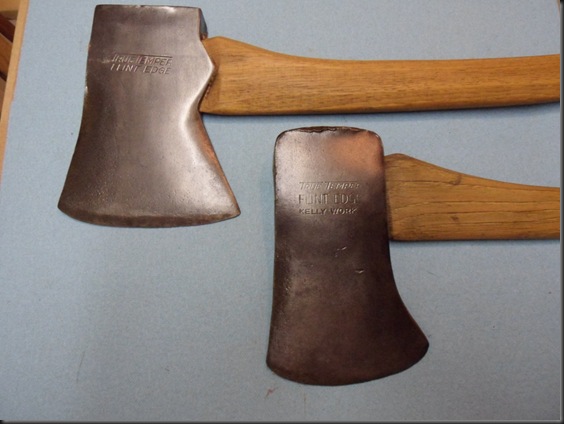
So now the AFHCo is in control, and not done with the changes yet.  Some years later, there is a restructing, and the axe division gets renamed to True Temper.  This is the name most people are familar with when it comes to Kelly Axes.  This rename to True Temper came about in 1949.  So remember, anything Kelly you see with TT on it should be post 1949.  I use this to gauge Kelly when looking at axes.  Now the fun starts because you will see axes marked TT Kelly Works on them - I take it this was to ensure that people knew that the True Temper name was associated with Kelly quality and name recognition.

Here is a simple example -

5

This is where you will really start to see the older names used by TT - I think this was done again for marketing/name recognition purposes - for people familar with the axe names used before such as Dynamic, Red Warrior, Falls City, HandMade, Vulcan, etc.

Couple examples -

6

7

So Kelly was able to stay in business somewhat longer than most axe makers - they made it until 1983 when the HQ was moved to Cleveland and the Charleston operation shut down.  This marked the end of a great run overall for this axe line that is widely known not only in the US, but also in Canada (Wellland Vale), Australia, and I am sure to whatever degree in south america.  The rights to the names of the line were sold to Barco Industries in 1987, and they still produce a couple lines of Kellys.  They are in Reading, Pa.

So now that the timeline is over, lets look back at some of their products.

Obviously they made hatchets - Here are a couple examples from the 70s.  Quality no where near the older lines.

8

Older hatchets -

9

They also made products for hardware companies as most of the axe manufacturers did -

10

11

12

Kelly made many different hardware lines - Keen Kutter being one of the most popular.  There are findings that say that Mann Edge Tool also made Keen Kutter at one time, so I didnt included any in here.

Kellys own lines -

Most are familar with perhaps the 2 most widely known lines of axes out there - Flint Edge and Kelly Perfect.  The Flint Edge line seems to be popular in numbers overall, while the Perfect line is also popular, and highly sought after.  The Kelly Perfect line incorporated single bits, double bits, hatchets, hammers, and other varous tools besides axes.  And let us not forget one of the most sought after Kellys - the Kelly Perfect Jersey.

Here are some examples -

3 timeline versions of Perfects -

13

14

And then the Flint Edge line -

15

16

17

As stated, Kelly made lines for all needs, including the RR.  Here are a couple Flint Edge RR lines -

18

Let us not forget some of the other Kelly Lines -

Black Raven -

This axe, with its huge imprint on the axe head of the Raven, holds some mystique in the axe world today.  When we look at it - we see the imprint, the fine work of the logo, and think, how could someone swing that into wood?  Yet it was a popular lline in its day - and usually highly sought after.

Of course, a couple pics!

19

20

The Black Ravens will have various wording on the imprint, which will help you to date them.  Some say Kelly Mfg Co, Tool Co, Kelly Works, and even American Fork and Hoe on the imprint.  Also, sometimes it will say True Temper on the back - giving you a better feel for how old the piece is.

The Registered Line -

This is one of the more unique lines in the axe history world - Kelly had a line where each axe got its own registered number.  This was seen on double bits and single bits.  I have been searching trying to find a link between registered number, and year of manufacturer.  None has been found that I know of, and I have no idea if it even exists.  I wonder if a true axeman really even cared about the number LOL.

Here is an example -

21

22

WellI hope this helped to shed a little light on the largest axe maker the world has ever seen.  It is a fascinating company, one with a long timeline, twists, turns, bumps and bruises.  I am sure that I left something out(like some of the other lines/companies they made for, like Marshall Wells), spelled something wrong, or messed up a date.  If I did please let me know.  Thanks to Axe Makers of North America, Yesteryear Tools, Kelly catalogs, other publications, and the good ole internet.  Hope you enjoy.

Thanks!